
Note: Michael Bugeja, guardian of Freya and Siggy, is a Basepaws affiliate member and may receive compensation for this post. Any compensation will be donated to the Ames Animal Shelter.
Last year we did a post of Siggy’s first DNA test from Basepaws (meow@basepaws.com, +1 (415) 634-PETS, 1820 W. Carson street, suite 202-351, Torrance, CA 90501).
We decided to do a second test because Basepaws had enhanced the science with more markers and information about various feline diseases (plus dental test).
The Basepaws upgraded digital report now provides results for over 115 known feline genetic health markers—65 markers for genetic health conditions and 50 markers for traits.
We wanted to re-test Siggy and get a test for Freya (knowing she is a pedigreed Maine Coon) primarily because of this new feature:
Genetic Markers for Feline Hypertrophic Cardiomyopathy
- Hypertrophic cardiomyopathy (HCM) is the most common feline heart condition. It causes an abnormal thickening of the heart’s muscular walls and compromises overall heart function, which can lead to a range of issues in other systems of the body.
- The Basepaws Cat DNA test now screens for two additional genetic health markers associated with HCM to let you know if your cat is at a higher risk for the disease.
- This knowledge, along with risk results for any of the other genetic conditions for which Basepaws screens, can be incorporated into a proactive care plan that supports the overall health and well-being of your beloved feline companion.
As with the first test, the enhanced new test comes with detailed instructions on how to swab for DNA. It’s very much like a human DNA procedure. Each kit includes a sterile cheek swab with stabilizing liquid, a biohazard specimen bag and prepaid packaging for return shipping.
Here are swabbing instructions:
“Ideally, we want the swab in your cat’s mouth for 5-10 seconds, but we understand that cats can be temperamental. In most cases, we can still reliably obtain good quality DNA if the swab is in the cat’s mouth for as little as 3-5 seconds, as long as you manage to make proper contact with the inner cheek, gums and/or tongue. Please make sure to wait at least 30 minutes after your cat consumes anything before swabbing to prevent contamination.”
Both Siggy and Freya allowed me to swab for 10 seconds each.
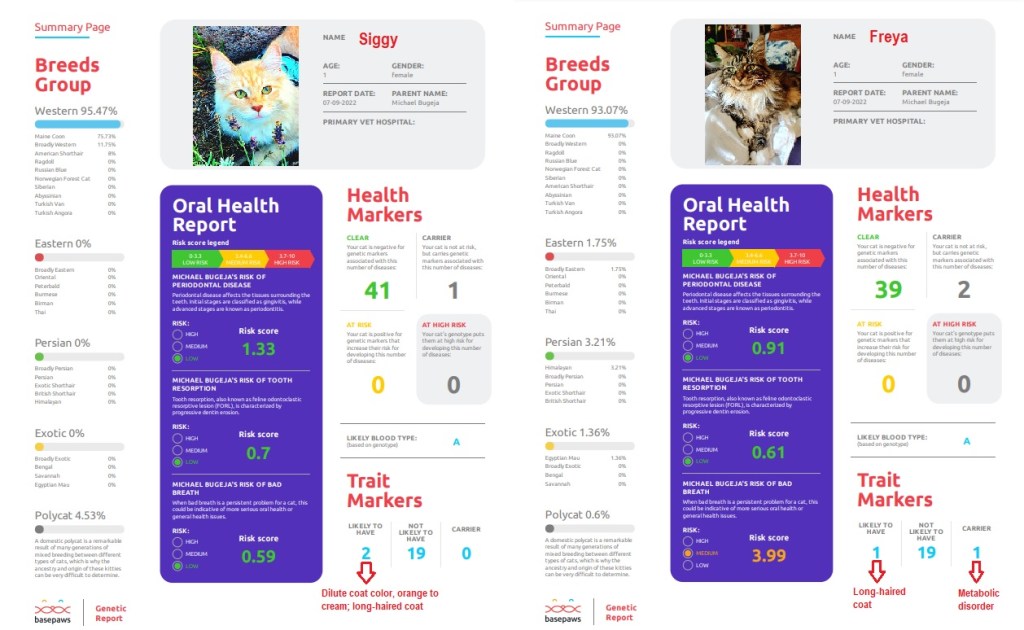
Siggy’s second test was much like her first.
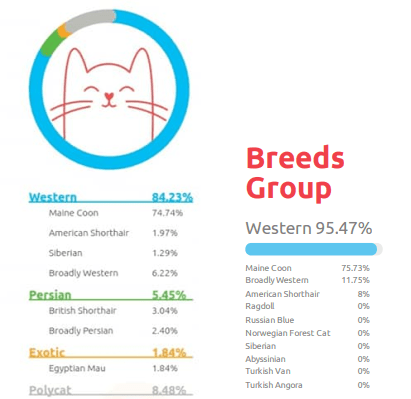
The genetic breakdown of the first test (left) shows 74.74% Maine Coon. The enhanced test shows 75.73% Maine Coon. The difference here is that the second test confirms Siggy is almost entirely Western. Once again, she is at low or no risk for tested diseases.
Both reports state that, but the enhanced one has so many more potential diseases.
Siggy got a clean bill of health, including dental.
It’s interesting, isn’t it, that Freya the pedigree, is 93% Maine Coon with a noticeable 3.21% Persian and 1.3% Exotic? While she is not at risk herself, she is a carrier of two disorders:
Pyruvate Kinase Deficiency: an inherited metabolic disorder characterized by disrupted survival of erythrocytes, leading to anemia, lethargy, weakness, weight loss, abdominal enlargement, and in some cases, jaundice, tachycardia, and muscle wasting. The prognosis and severity are variable.
Hypertrophic Cardiomyopathy: (HCM) is the most common feline heart disease, and it is characterized by tachycardia and the thickening of the heart’s muscular walls. The severity of the disease is variable, but if diagnosed early, different treatment options are available
We were especially worried about HCM, of which Maine Coons are especially prone–up to 30% carry the mutation. According to the NC State Veterinary Medicine Hospital, “DNA test results will indicate if the cat has the mutation on 1 copy of its 2 gene copies (heterozygous) or both gene copies (homozygous). Most cats that are heterozygous for the mutation will NOT get sick. However, most cats that are homozygous (have 2 copies of the gene) will eventually develop the disease and may become sick.”
Thankfully, Freya only has one copy of the mutation. She is spayed. However, if she had kittens, chances are those would have two copies and be at risk for the disease.
We purchased Freya as a pet and not as breeding stock. As such, were I to purchase another Maine Coon for breeding purposes, I would ask for a DNA test of the mother to see if she is an HCM carrier (like Freya).
For these and other reasons, I enthusiastically recommend Basepaws for cat owners, not only for the fun of learning about breeds, but for the disease markers.
I will be sharing copies of both reports with my veterinarian.
 Maine Coon Adventures
Leave a comment